

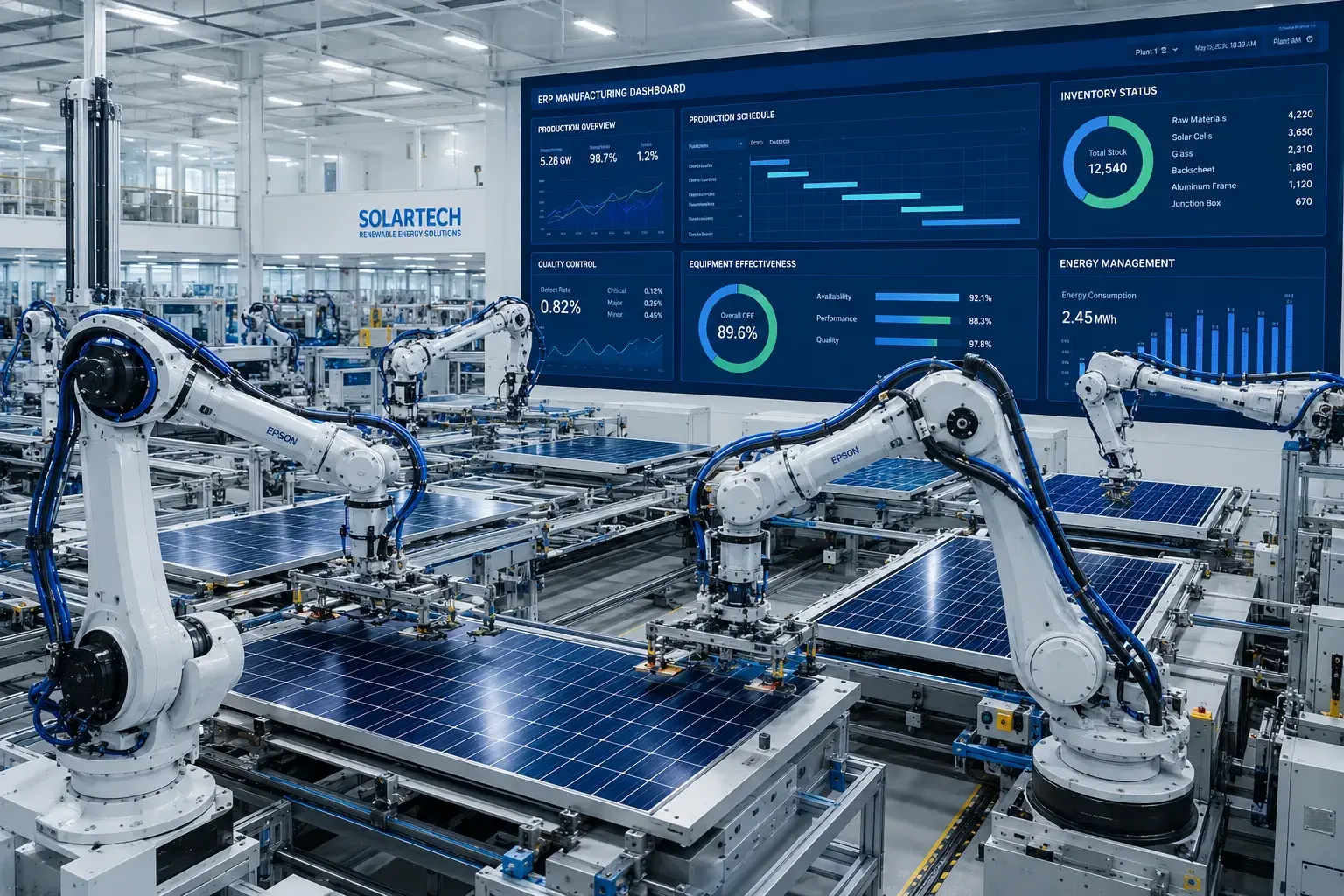
The Solar Boom Is Here – Is Your Factory Ready?
The global solar energy market is growing at a pace that would have seemed unimaginable a decade ago. According to the International Energy Agency (IEA), solar PV capacity additions reached a record 413 GW in 2023 – representing nearly half of all new electricity capacity added worldwide. Analysts project the market will cross USD 500 billion by 2030, fuelled by net-zero commitments, falling panel costs, and surging electricity demand across every continent.
For solar panel and PV module manufacturers, this growth is a double-edged sword. On one side lies enormous commercial opportunity. On the other lies mounting operational complexity – more product variants, tighter quality tolerances, volatile raw material prices, demanding customers, and ever-tightening regulatory requirements.
Running a modern solar factory on spreadsheets or a generic business system is no longer viable. Digital transformation is now the competitive baseline. Industry leaders are turning to purpose-built Solar Panel Manufacturing Management Software to unify their operations, reduce waste, and scale with confidence. This guide introduces Smart ERP for Solar & PV Industry, explains what it does, and shows you why it is the platform solar manufacturers have been waiting for.
Challenges Faced by Solar Panel Manufacturers Today
Before diving into the solution, it is worth understanding the pain points that make solar manufacturing uniquely complex.
Production Planning Issues
Dozens of interdependent process steps – wafer slicing, diffusion, lamination, framing – create bottlenecks that manual planning simply cannot resolve at scale.
Inventory Management
Volatile prices for silicon, silver paste, and encapsulant film mean overstocking ties up capital while understocking halts production lines.
Raw Material Tracking
Solar cells degrade based on material batch quality. Tracing every cell back to its silicon ingot manually is error-prone and too slow for high-volume output.
Quality Control Problems
EL imaging, IV curve testing, and visual inspection generate enormous data volumes that must be captured and acted on instantly to prevent costly warranty claims.
Supply Chain Complexity
Global sourcing means a delayed silver paste shipment from Asia can stall an entire facility. Without visibility, reactive firefighting replaces proactive management.
Regulatory Compliance
IEC 61215, IEC 61730, RoHS, REACH, and carbon reporting requirements are growing annually. Documentation errors can block shipments or invalidate warranties.
Cost Management
Material costs represent 60–70% of total production cost. Without granular cost tracking, margin improvement is largely guesswork.
Lack of Real-Time Visibility
When procurement, production, and finance are working from different systems, decisions lag behind reality and risks escalate unnoticed.
What Is Solar Panel Manufacturing Management Software?
Solar Panel Manufacturing Management Software is an integrated digital platform purpose-engineered for the unique workflows of solar and PV module production. Unlike generic enterprise software, it maps directly to processes like cell sorting, string assembly, lamination scheduling, and flash testing – the operational realities of a solar factory.
At its core, it connects every department – procurement, production, quality, warehouse, sales, and finance – into a single unified system. It captures data in real time, automates routine tasks, enforces compliance checkpoints, and surfaces actionable intelligence through live dashboards and reports.
Introducing Smart ERP for Solar & PV Industry
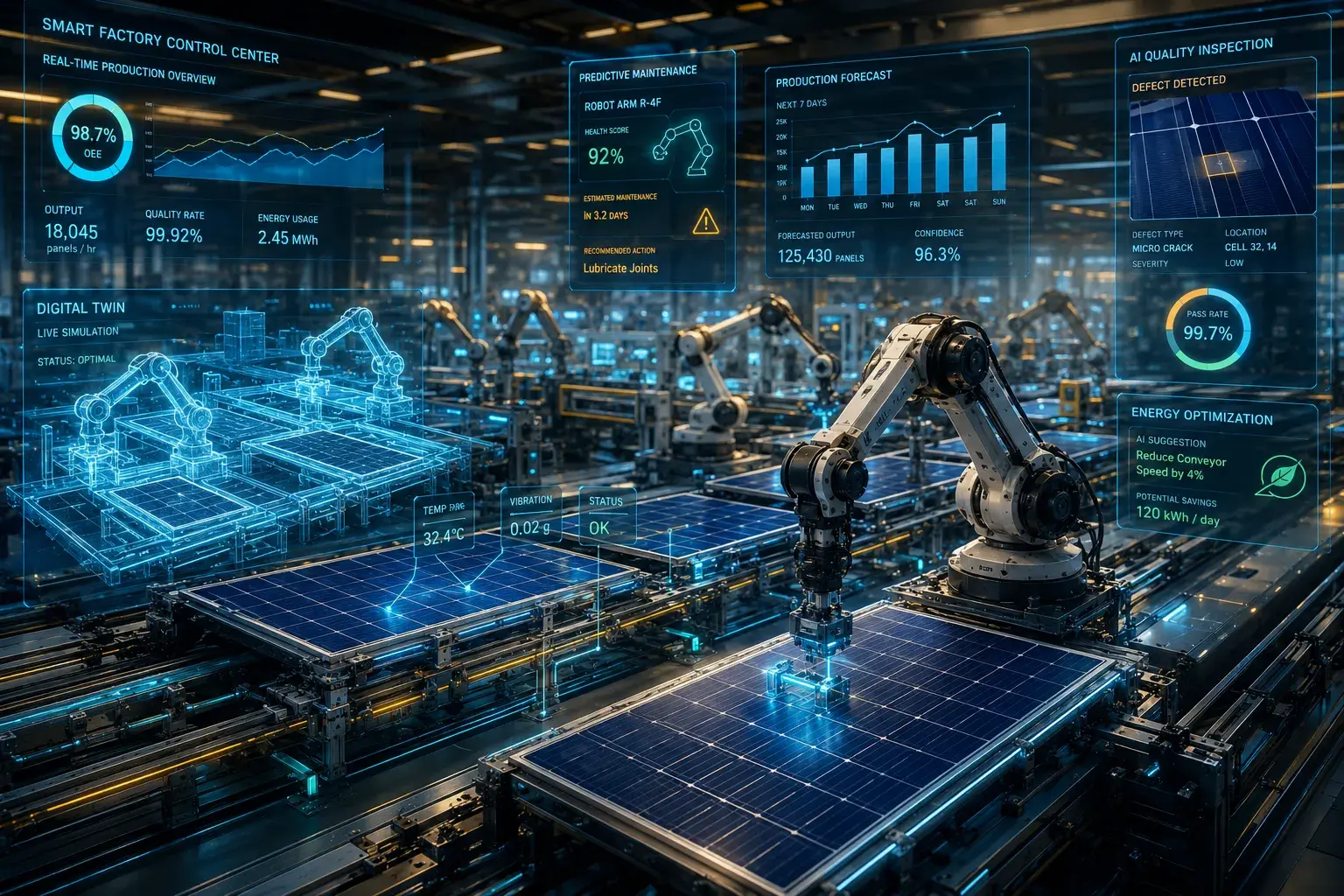
Smart ERP for Solar & PV Industry is a comprehensive Solar ERP Software platform built from the ground up for solar panel and PV module manufacturers. Every module, every workflow, and every data model has been designed with solar production in mind – not adapted from a generic manufacturing template.
Where legacy ERP systems force solar manufacturers to work around ill-fitting processes, Smart ERP fits around your factory. From the moment a purchase order is raised to the moment a pallet of panels leaves your dock, Smart ERP orchestrates every step – automatically, accurately, and in real time.
What makes it different from generic ERP? Three things: solar-native workflows, deep traceability at the cell and batch level, and built-in quality gates aligned with IEC standards. It does not require months of costly customisation to work the way a solar factory works – it already does.
Key Features of Smart ERP for Solar & PV Industry
1. Production Planning & Scheduling
Smart ERP’s advanced planning engine models your factory capacity in real time – machines, labour, tooling, and energy. It generates feasible production schedules aligned with sales orders and material availability, automatically flags conflicts, and resequences jobs when priorities change. The result: higher machine utilisation, fewer rush orders, and reliable delivery commitments.
2. Bill of Materials (BOM) Management
Every solar module variant – monocrystalline, polycrystalline, bifacial, half-cut – has its own BOM. Smart ERP maintains versioned, multi-level BOMs that drive procurement, production, and costing simultaneously. Engineering change orders propagate automatically, ensuring production always builds to the current specification.
3. Raw Material & Inventory Management
Real-time stock positions across all warehouses, production stores, and in-transit locations are visible at a glance. Minimum stock alerts, automatic reorder triggers, and safety stock calculations prevent stockouts without inflating carrying costs.
4. Procurement Management
From approved vendor lists to three-way invoice matching, Smart ERP covers the full source-to-pay cycle. Automated purchase requisitions, competitive quote management, and on-time delivery tracking give procurement teams the data they need to negotiate better terms.
5. Warehouse Management
Barcode and QR-code driven goods receipt, putaway, picking, and dispatch keep warehouse operations accurate and fast. Smart ERP supports multi-bin locations, FIFO/FEFO lot rotation, and full pallet tracking – eliminating discrepancies between physical stock and system records.
6. Quality Control & Testing
Quality gates are embedded at every critical production stage – incoming material inspection, in-process checks during cell and module assembly, and final flash testing. Test results including IV curve data and EL images are stored against each unit and linked to its full production history.
7. Batch & Lot Traceability
Complete forward and backward traceability from raw silicon to finished module is a standard feature, not an add-on. If a quality issue emerges in the field, Smart ERP identifies every affected unit in minutes – enabling targeted recalls rather than blanket withdrawals.
8. Supply Chain Management
End-to-end supply chain visibility: supplier performance scorecards, inbound shipment tracking, demand-driven replenishment planning, and scenario modelling for supply disruptions. Simulate the impact of a delayed shipment on your production schedule before it becomes a crisis.
9. Vendor Management
Centralise all supplier data – certifications, lead times, pricing history, quality records, and contract terms – in one place. Automated supplier scorecards quantify performance over time, giving procurement managers an objective basis for vendor selection.
10. Maintenance Management
Schedule preventive maintenance based on machine hours and production cycles, track spare parts inventory, and log every maintenance event. Recurring failure patterns are surfaced automatically, enabling condition-based maintenance before breakdowns occur.
11. Sales & CRM Integration
Sales orders flow directly into production planning, eliminating manual re-entry errors. Customer-specific pricing, delivery schedules, and product specifications are enforced automatically. CRM features track prospects, manage quotations, and monitor customer satisfaction.
12. Finance & Accounting
Cost of goods sold, WIP valuation, purchase accruals, and revenue recognition are calculated in real time from operational transactions – not re-entered manually at month-end. Supports multi-currency, multi-entity consolidation.
13. Business Intelligence & Dashboards
Role-specific dashboards surface the metrics that matter most to each function: OEE for production managers, fill rates for supply chain, open receivables for finance, and revenue per watt for executives. Drag-and-drop report builders allow custom analyses without IT involvement.
14. Real-Time Reporting
Scheduled and ad-hoc reports covering production output, quality yields, inventory turns, supplier performance, and financial results are available on demand – always based on live data, not a nightly batch feed.
15. Mobile Accessibility
Smart ERP is fully functional on smartphones and tablets. Warehouse operators scan barcodes on the shop floor. Quality inspectors log results beside the test bench. Plant managers review dashboards from anywhere in the world.
Benefits of Implementing Smart ERP for Solar & PV Industry
Real-World Manufacturing Workflow: Smart ERP in Action
The procurement module identifies a silicon wafer shortage against the production plan and automatically generates a purchase requisition, routes it for approval, and issues a PO to the preferred vendor – without leaving the system.
The vendor’s delivery arrives at the warehouse. The goods receipt officer scans the packing slip barcode. Smart ERP verifies quantities against the PO, assigns lot numbers, and triggers an incoming quality inspection.
With materials confirmed available, the planning engine builds a feasible schedule for the current week’s orders – assigning work centres, balancing machine loads, and allocating material from specific lots to specific production orders.
Shop-floor operators work through digital job cards on tablet terminals. Each process step is confirmed and timestamped. Material consumption is recorded automatically, and any deviations from standard are flagged in real time.
Every module undergoes flash testing. IV curve results and visual inspection scores are uploaded directly from the test equipment into Smart ERP, linked to the module’s serial number. Modules outside specification route automatically to a rework queue.
Passed modules are matched against the sales order and packed. Smart ERP generates carton labels, packing lists, and shipping documentation – all with the serial numbers and certifications required by the customer.
Finished goods are scanned out of the warehouse. Smart ERP updates inventory in real time, generates the commercial invoice and delivery note, and sends the customer an automatic shipment confirmation with tracking details.
After delivery confirmation, Smart ERP closes the production order, reconciles actual versus standard costs, updates financials, and archives the complete batch record – ready for any future warranty or compliance query.
Why Solar Manufacturers Need Industry-Specific ERP Software
| Capability | Generic ERP | Smart ERP for Solar & PV |
|---|---|---|
| Solar-specific BOM structures | Expensive customisation required | Built-in, ready to use |
| Cell & module-level traceability | Not supported natively | Full forward/backward traceability |
| Quality gates aligned with IEC 61215 / 61730 | Manual process, no templates | Pre-configured workflows |
| Flash test & EL data integration | Requires third-party middleware | Native integration |
| Solar process-aware production scheduling | Generic capacity planning only | Multi-stage solar scheduling |
| Watt-peak (Wp) & efficiency-based reporting | Not available | Standard KPI library |
| Regulatory compliance documentation | Manual document management | Automated compliance workflows |
| Sustainability & carbon tracking | Not applicable | Built-in energy & carbon module |
| Implementation timeline | 12–18 months typical | 4–8 months with solar templates |
| 5-year total cost of ownership | High – extensive customisation | Lower – pre-built for solar |
The Future of ERP in the Solar Industry
AI-Driven Forecasting
Machine learning models analyse order patterns, market signals, and weather data to generate more accurate demand forecasts – reducing excess inventory and emergency schedule changes.
Predictive Maintenance
Sensor data from production equipment feeds into the maintenance module to predict component failures before they occur – scheduling interventions during planned downtime windows.
Industry 4.0 & IoT
Smart factories connect every machine and sensor to the ERP in real time, enabling closed-loop process control that automatically adjusts parameters to maintain quality targets.
Digital Twins
A virtual replica of your factory runs in parallel with the physical plant, letting manufacturers simulate process changes, test scheduling scenarios, and optimise energy consumption risk-free.
Sustainability Tracking
As Scope 3 reporting requirements tighten, ERP systems with native sustainability modules will be the infrastructure that makes carbon reporting accurate and auditable across the supply chain.
Conclusion
The solar industry’s extraordinary growth creates extraordinary opportunity – but only for manufacturers who can operate with the speed, precision, and intelligence that modern production demands. Spreadsheets and generic business software cannot deliver that. A purpose-built Solar Manufacturing ERP System can.
Smart ERP for Solar & PV Industry gives solar and PV module manufacturers a single, unified platform that connects procurement, production, quality, warehouse, sales, and finance into one coherent operational picture. It is solar-native, deeply configurable, and built to scale alongside your business.
The manufacturers who invest in the right digital infrastructure today will be better positioned to win contracts, protect margins, and meet regulatory requirements tomorrow. The energy revolution is already underway. The question is whether your ERP system is ready to power it.
Ready to Transform Your Solar Manufacturing Operations?
Book a personalised demo with our solar industry specialists and see Smart ERP in action – built for your factory, not adapted from a generic template.
Request a Free Demo Today